
Life on Earth is dependent on photosynthesis to form carbohydrates at the base of the global food chain. When the world’s major crops are grown under well-managed conditions with optimal fertilizer and irrigation, maximum yield is set by the rate of photosynthesis. Four factors impact on photosynthetic efficiency in the field, the first of which is outside of human control:
- Total solar energy that lands on a crop over its lifetime;
- The efficiency with which the leaf canopy intercepts and captures the sun’s energy;
- The efficiency with which the sun’s energy is converted into carbohydrates; and
- The Harvest Index (HI) – i.e. the efficiency with which carbohydrates are partitioned into the harvested organs (i.e. food, fibre or fuel).

Since the Green Revolution of the 1960s, yields have increased dramatically because of better genetics, agronomy and crop protection. Genetic improvements have been achieved largely by selecting varieties with an enhanced ability to intercept and capture light (factor 2) and/or with improvements in HI (factor 4). With this approach, the proportion of photosynthetically active radiation that is intercepted over the growing season has reached 0.8-0.9, and the HI has almost doubled. In contrast, the efficiency with which solar energy is converted into carbohydrates has not altered within individual crops. This observation suggests that there is limited scope to enhance the efficiency of photosynthetic pathways. However, given that the more recently evolved ‘C4‘ photosynthetic pathway is up to 50% more efficient than the ancestral ‘C3‘ pathway, introducing C4 traits into a C3 crop could have a dramatic impact on crop yield.
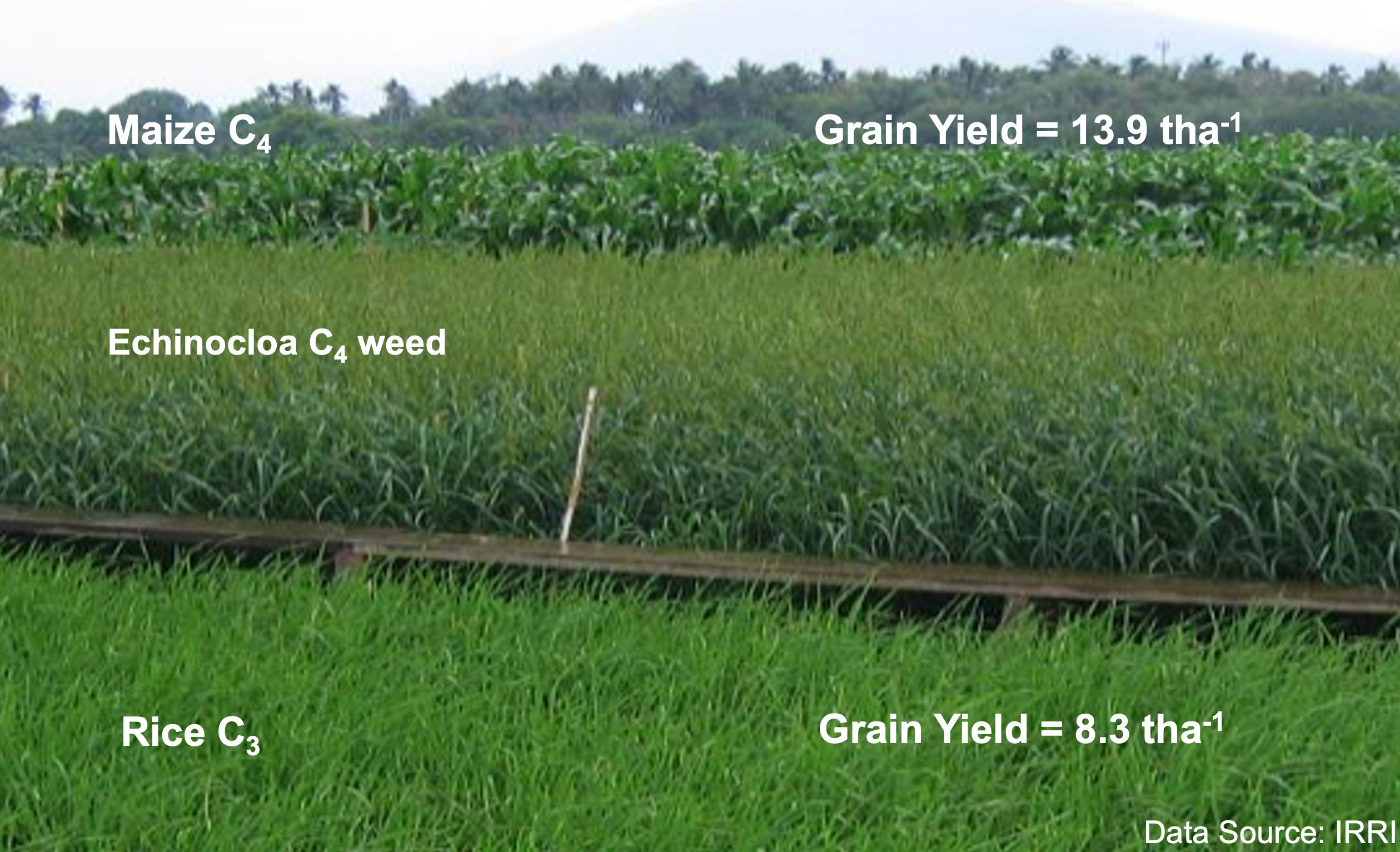
In warm dry environments, both vegetative biomass and grain yield are higher in C4 photosynthesing species than in C3 species, regardless of whether those species have been domesticated for food production.
 c4rice.com